
The Good Life? Exploring Human Capital Sustainability Among UK Freelance Translators
Joseph Lambert 1, Cardiff University
JC Penet2, Newcastle University
Callum Walker3, University of Leeds
The Journal of Specialised Translation 46 (2026), 2-20
XXXhttps://doi.org/10.26034/cm.jostrans.2024.4724XXX

ABSTRACT
Alongside mixed perspectives on the growth of the global language services industry, there have been increasing concerns over the state and sustainability of the translation industry. In this article, we interrogate the human capital sustainability of UK-based freelance translation, shifting the focus of discussions from technology to translator wellbeing. We define wellbeing in the context of translation as a balance between social, physical, and psychological resources and challenges and build upon prior, related conceptual explorations in the area. Using data from a UK-based survey of 209 freelance translators and three focus groups, we empirically assess translator wellbeing via self-reported narratives of belonging, esteem, and self-actualisation. Our findings reveal considerable professional pride and high intrinsic fulfilment alongside a fractured sense of community, low perceived public status, and restricted career progression. These tensions confirm a “motivation-satisfaction paradox” in which translators attain self-actualisation despite deficits in lower-order needs, and expose vulnerabilities in the industry’s social and psychological resource base. We argue that addressing these imbalances is essential to retaining talent and safeguarding longer-term industry viability, calling for a collective duty of care alongside individual practices of self-care to enshrine translator wellbeing as the ethical foundation of sustainable development.
KEYWORDS
Sustainability, human capital, wellbeing, self-care, freelance translators.
1.The translation industry: A growing market “on a slippery slope”?
What industry can thrive if its workers are overworked, undervalued, and exhausted? In financial terms, the global language services industry has shown buoyant growth for many years, but concerns have started to emerge around a “market on a slippery slope” (ELIS, 2025, p. 12). While broader industry developments and individual professionals’ fortunes do not always align, such a downturn naturally “hits small language companies and independent professionals […] hard” (ELIS, 2025, p. 5)1. It is therefore hardly surprising that existential sustainability concerns have increased, especially for and among some freelance translators. Issues of working conditions, pay, and status, and a complex professional conjuncture more generally have compounded complaints around job (dis)satisfaction (Lambert and Walker, 2024; Rodríguez-Castro, 2024; Ruokonen and Svahn, 2024), leading some to question their place in the industry.
While coverage of sustainability is gaining momentum in Translation Studies (TS), contributions remain fractured, and much sustainability-based research to date has understandably been preoccupied by technology and automation (for instance, Moorkens et al., 2024). In this article, we briefly review core components of sustainable development (SD) for the translation industry before redirecting the sustainability narrative away from technology to humans and, specifically, freelance translators. We identify human capital retention issues as key to SD and contingent upon work-related wellbeing (Penet, 2024a, p. 192), with issues here potentially leading professionals to seriously consider abandoning translation.
We have explored these human capital sustainability issues at a conceptual level in a previous article (Lambert and Walker, 2024), in which we considered the extent to which translators’ needs are met using Maslow’s famous Hierarchy of Needs. This analysis uncovered a range of issues even at the most basic levels, but found that many translators remain content with their work despite the bleak outlook, forming the basis for our motivation-satisfaction paradox hypothesis, echoing findings from Dam and Zethsen (2016). In this article, we put our conceptual model to the test using empirical survey and focus group data from the “Chasing Status” project, which set out to better understand UK-based freelance translators’ perspectives on the current industry climate2. We return to Maslow’s influential model, and analyse UK freelance translator’s narratives of belonging, esteem, and self-actualisation. We use these broad categories as indices that enable us to map out translators’ work-related wellbeing and conclude with reflections on the potential of (self-)care.
2. Sustainability in/of the translation industry
2.1. From technology to people: A triple bottom line for the translation industry
Sustainability has been a pervasive theme in global policy and academic discourse for decades. The Brundtland Commission Report’s (UNWCED, 1987, p. 16) foundational definition of SD as an approach that “meets the needs of the present without compromising the ability of future generations to meet their own needs” marked a key turning point, and its broad scope and global aims have been enshrined in the UN’s sustainable development goals since 2015. In TS, sustainability has garnered attention as a vital, multifaceted concept. An enduring framework that captures the range of sustainability challenges we face is Elkington’s triple bottom-line model, foregrounding the porous and interdependent ‘Three Ps’ of people, profit, and planet, underscoring the environmental, social, and economic bases of sustainability (Elkington, 1997). While originally conceptualised for use in business contexts, this model neatly encompasses the range of challenges facing the translation industry today. Moorkens et al. (2024, p. 8) laud the model’s longer-term social and entrepreneurial vision, moving away from “a single bottom line that looks only at immediate economic profit”, and adapt this model to stress the urgency of considering automation-induced sustainability challenges. They replace ‘profit’ with ‘performance’, arguing that performance is the corresponding concept in the domain of technology, prompting discussions of translation quality rather than pricing, economics, or human capital issues. We take a different approach here, retaining this focus on ‘profit’, which encompasses considerations of both economic and human capital. Beyond ties to technology, the social strand encompasses the interests of all stakeholders involved in the industry. This is a broad category, spanning translators, Language Service Provider (LSP) executives, end users, institutions, and even the general public. Equally, the ‘profit’ side has a similarly broad base. Although there is growing interest in the more literal, financial side of economic sustainability (Hanson et al., 2025; Walker and Lambert, 2024), we situate our thinking in Elkington’s link between social and economic sustainability, human capital issues, and wellbeing. These areas foreground the professionals at the centre of the industry and remain under-explored in TS, despite arguably supporting the social and environmental pillars.
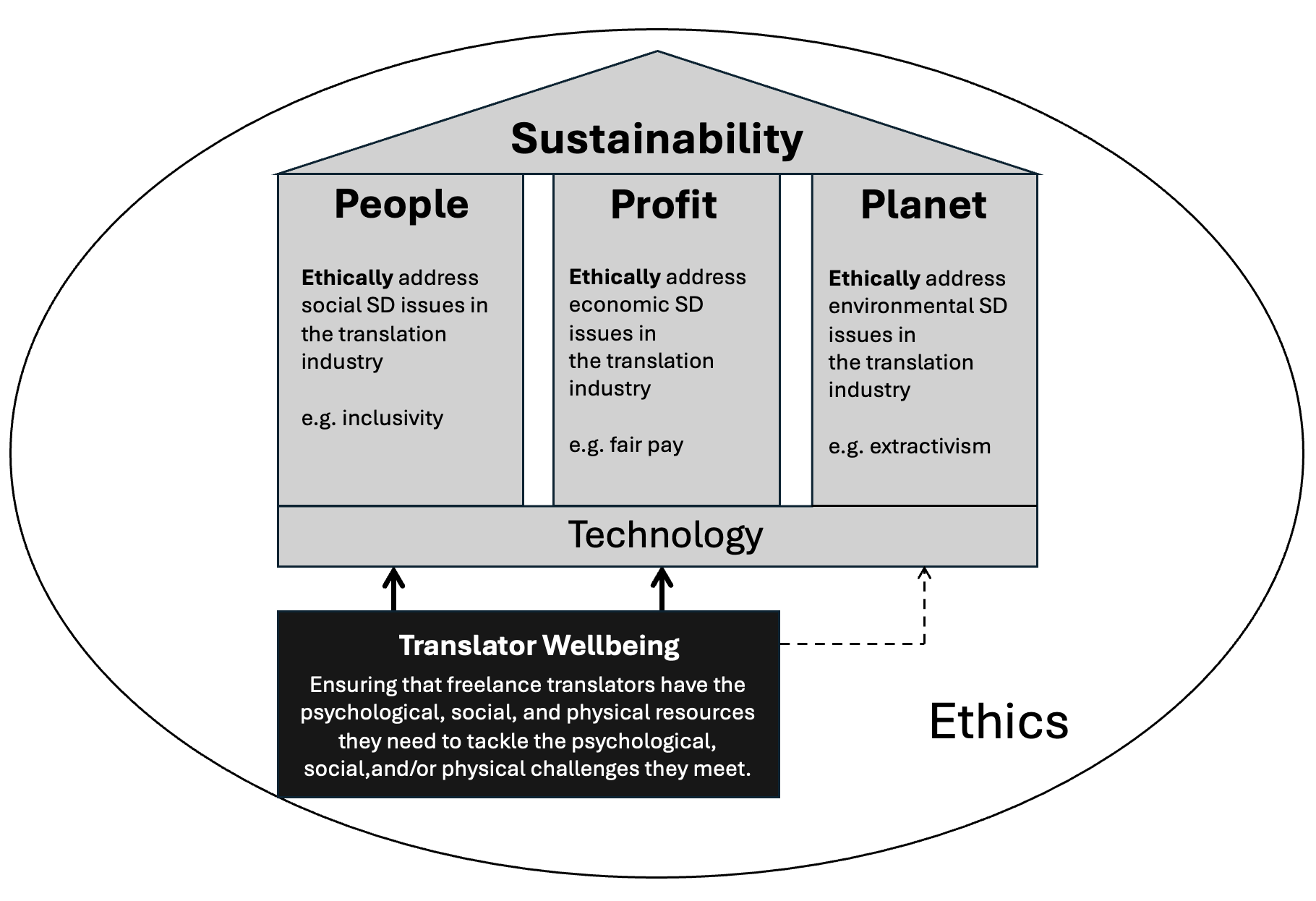
Figure 1. The triple bottom line for translation and the centrality of ethics and wellbeing in addressing sustainable development (SD) issues in the translation industry
In contrast to our approach, technology has typically been front and centre across the TS literature on sustainability – perhaps understandably, as technological disruption continues to fuel change across the language industry. Beyond its clear link to environmental harms, technology also represents an unavoidable undercurrent of ‘People’ and ‘Profit’, as shown in Figure 13. Arguably, automated workflows represent a source of ethical issues – both economic and social – for the industry, as they affect pricing and working conditions inter alia (see Fırat, 2021; Giustini, 2024). However, focusing purely on technology risks diverting our attention from the crucial role and experiences of the people at the heart of the industry. This concern has been reflected in recent literature with, for instance, Riemland’s (2023, p. 249) theorisation of an alternative approach to machine translation (MT) that blends ecological and social perspectives, or Monzó-Nebot and Tasa-Fuster’s (2024) ethics-of-care approach to MT, which combines technological and social elements of sustainability.
Conceptually, the link between ethics and sustainability is unexplored in TS, despite the almost reciprocal link between the two. As per Figure 1, we posit that ethics occupies a space underpinning sustainability, providing a moral justification for calls for sustainability. In Elkington’s model, ethics guides businesses in ensuring fair labour practices, human rights, community wellbeing, and social justice, ethical principles demand responsible environmental stewardship. However, as noted here, and somewhat paradoxically, his ‘social’ pillar (people) is also described as covering ethical concerns, blurring the seemingly fixed boundary between the three pillars.
2.2. Translator wellbeing and human capital sustainability
Economic SD includes not only physical and financial capital, but also human capital as “a measure of the experience, skills, and other knowledge-based assets of the individuals who make up an [industry]” (Elkington, 1997, p. 74). A key question in the translation industry is ensuring that human capital does not migrate out of the industry (Lambert and Walker, 2024, pp. 90–91). In keeping with ELIS reports from 2023 onwards, the 2025 edition worryingly shows that confidence in a sustainable future continues to decline among independent language professional across all experience levels (2025, p. 19), with many not “yet sure what to do to get off the slippery slope” (2025, p. 5) and junior colleagues (0-2 years’ experience) having the most pessimistic views (2025, p. 41).
One side of the equation involves confronting issues of working conditions (e.g. Moorkens, 2020), rates of pay (e.g. Fırat et al., 2024), status (Lambert and Walker, 2022), and ensuring a pipeline of qualified professionals (Lambert and Walker, 2024). The other entails ensuring that professionals are well enough and motivated to work to the standard required and feel secure in their employment (Moorkens, 2020, p. 28; Rodríguez-Castro, 2015, p. 35), let alone to challenge the status quo and tackle environmental issues.
Despite growing recognition that wellbeing is “an essential part of a sustainable life and career”, it is “not often linked to sustainability issues in popular discourse” (Hubscher-Davidson and Panichelli-Batalla, 2025, p. 444), with ecological and socioeconomic concerns often taking centre stage. However, industry professionals are “not immune to sustainability challenges or to the detrimental impacts these can have on physical health, mental wellbeing, and job satisfaction” (Hubscher-Davidson and Panichelli-Batalla, 2025, p. 444; see also Chiesa et al., 2018).
In TS, the importance of wellbeing and related constructs such as job satisfaction and work engagement is now widely known (cf. Chen, 2023; Hubscher-Davidson, 2018,; Hubscher-Davidson and Lehr, 2022; Penet, 2024a, 2024b). Similarly, in the UK translation industry wellbeing has grown in prominence among professional associations. Both the Institute of Translation and Interpreting (ITI)4 and Chartered Institute of Linguists (CIOL)5, for instance, have published resources on health, wellbeing, stress management, and resilience, and there is a clear appetite among professionals to confront these issues. However, despite this growing interest, wellbeing still has not been clearly defined in our field, including in articles addressing the concept (cf. Bednárová-Gibová and Majherová, 2021; Mahadin and Naser Olimat, 2022; Chen, 2023). This is understandable given that wellbeing is notoriously challenging to define (Dodge et al., 2012), in part due to the two differing, historical approaches to the concept. The first, known as the hedonic approach, equates wellbeing with happiness and pleasure. Here, “the good life consists of a life with more positive than negative pleasures” (Scaria et al., 2020, p. 4). The second, however, is based on Aristotle’s view that “living a life of virtue is of greater worth than seeking out pleasure” (Searle, 2008, p.11). According to this approach, known as the eudaimonistic approach, wellbeing is about “meaning and self-realisation” (Searle, 2008, p. 11). The eudaimonistic approach is therefore primarily concerned with psychological wellbeing, as attested by Rogers’ (1967, p. 185) description of “the good life” not as a fixed state, but as “a process” towards becoming a “fully functioning person”. Clearly, and like SD, wellbeing is a “complex, multifaceted construct” (Pollard and Lee, 2003, p. 60). As highlighted by Searle (2008, p. 12-13):
Although there is no overall consensus on whether ‘happiness’ or ‘self-fulfilment’ is the best measure of subjective well-being, what these arguments have developed is the principle that subjective well-being is not simply the opposite to psychological disorder, or the absence of negative factors, but is a multifaceted entity in its own right, arising from complex relationships involving both the individual and their environment.
Consequently, we would like to propose our own definition of translator wellbeing inspired by Dodge et al.’s (2012, p. 230). As represented by Figure 2, translator wellbeing can be seen a see-saw that is stable when translators feel they have the psychological, social, and physical resources they need to meet the psychological, social, and/or physical challenges they face in their industry and, therefore, feel they can self-actualise as translators. Extrapolating from the explanation offered by Dodge et al. (2012), we can appreciate that when translators “have more challenges than resources, the see-saw dips, along with their wellbeing, and vice-versa”. Just as excessive challenges will deflate a translator's resources to the point of exhaustion, insufficient challenge risks stagnation. Ultimately, translator wellbeing can be found in the perfect equilibrium between resources and challenges.
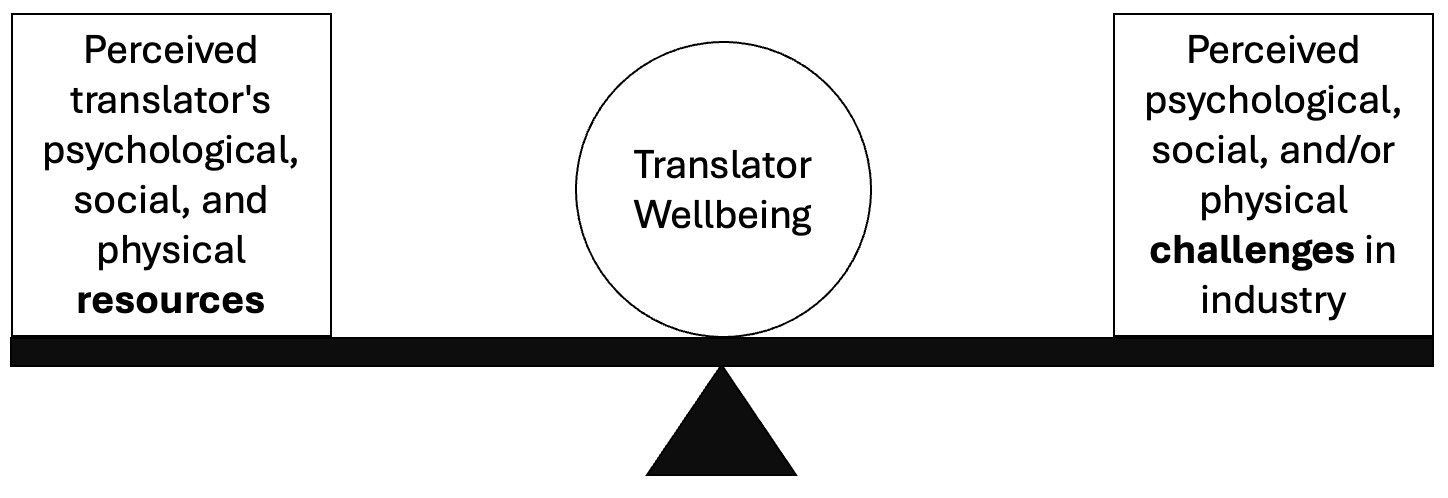
Figure 2. Proposed definition of translator wellbeing based on Dodge et al. (2012, p. 230)
Using Ehrensberger-Dow’s work on ergonomics (see 2020 for an overview), Penet (2024a, p. 186) has already categorised some of the main physical, cognitive/psychological, and organisational/social challenges – which he calls “stressors” – that translators may face in their work (Penet, 2024a, p. 186). More recently, the cost-of-living crisis, the economic climate, technological change, rates and income, and time management feature as prominent cognitive and social challenges (ELIS, 2025, p. 23) that may threaten the wellbeing of UK freelance translators. If left unchecked, these may lead to burnout or force translators to leave the profession (see, for instance, mention of now well-established talent shortages in Nimdzi, 2025, p. 11).
Hence, wellbeing directly links back to human capital concerns. Indeed, in an interpreting context, Yan and Jia found that “occupational stress positively predicts turnover intentions” (2025, p. 10) and that grit – defined as “the enduring passion and sustained motivation to stay in the profession and overcome occupational challenges and adversity” (2025, p. 4) – represents a significant negative moderating factor. Ultimately, we would contend that wellbeing should be more central in discussions around the sustainability of the translation industry, given that translator wellbeing can be seen to determine translators’ ability to respond ethically to the social, economic, and environmental SD challenges the industry is facing. As shown in Figure 1, individual wellbeing is indivisibly tied to collective health and industry-wide productivity, and therefore translator wellbeing arguably acts as the foundation for the industry’s sustainability.
Resultantly, forming a better understanding of translator wellbeing in today’s challenging industry climate is one of the key tasks facing TS scholars. It is with this rationale in mind that, in the rest of this article, we explore translator wellbeing through perspectives from UK-based freelance translators using Maslow’s Hierarchy of Needs as an orienting framework (see Lambert and Walker, 2024). This framework, which has emerged from the psychological concept of self-actualisation and, therefore, the eudaimonic tradition of wellbeing, offers broad conceptual categories to explore translator wellbeing and, consequently, human capital sustainability concerns. In the hierarchy, basic needs must be fulfilled before individuals can attend to higher-level needs. To self-actualise, individuals need safety (including psychological safety), belonging, and recognition. Lambert and Walker (2024, p. 99) found “clear deficiencies at every level, even the most basic, which impacts translators’ willingness to enter into, and remain in, the profession”6. At the most basic level, there are concerns over the amount of rest translators get, but “for most translators in the UK at least, basic needs are likely met” (Lambert and Walker 2024, p. 97). At the level of safety, “while concerns over physical safety are thankfully rare, there are pressing concerns in relation to emotional wellbeing and financial and job security” (Lambert and Walker 2024, p. 94). While financial and job security are addressed in other publications (e.g. Penet et al., in press), wellbeing concerns are outstanding.
Below, partly owing to space constraints, we focus on Maslow’s categories of belonging, esteem, and self-actualisation to explore the resources and challenges mentioned above (see Figure 2). In addition, Maslow’s framework allows us to consider motivation and satisfaction, which are also key drivers behind human capital retention. Ultimately, this should help us understand whether UK freelance translators feel they can still self-actualise as translators and, therefore, whether they have the resources to maintain their overall work-related wellbeing.
3. Data collection and handling
This article draws on data collected from a questionnaire distributed to ITI and CIOL members in October 2023 and three focus groups in December 20237. For the ITI, 1,100 members (excluding student members) were chosen at random to receive the survey by the ITI and contacted by email; for the CIOL, all members (~3,000) were invited to participate via the CIOL’s regular “Monthly Update” email. Our analyses in this article are based on UK-based freelance translator respondents only (n = 209, out of a total of 331 usable responses) and all focus group participants (n = 28). All survey respondents and focus group participants signed informed consent forms prior to completing the questionnaire or participating in the focus groups.
3.1. Datasets
Of the 209 survey respondents, 163 were women, 43 men, 2 non-binary, and 1 did not answer. The mean age was 49.9 years (SD = 14.4), and mean experience was 15.1 years (SD = 8.6). 124 respondents (59.3%) worked full-time as freelance translators; 49 part-time (23.4%); 27 part-time alongside other employment (12.9%); and 9 (4.3%) described themselves as “occasional” translators. In terms of client mix, 53 (25.4%) worked exclusively for LSPs, 90 (43.1%) worked predominantly for LSPs (70-90% of their work); 21 (10.0%) had a balanced portfolio between LSPs and direct clients (40-60% of their work); 27 (12.9%) worked predominantly for direct clients (only 10-30% of work from LSPs); and 18 (8.6%) worked exclusively for direct clients.
Focus group participants were selected from an open call to ITI geographical networks to ensure a diverse, but representative sample of translators. Across the three focus groups, 22 were women and 6 were men. 18 worked full-time as a translator, 4 part-time, and 6 part-time alongside other employment. The mean experience as a translator was 13.5 years (SD = 8.7). Their sources of work were also relatively balanced, with 4 working for LSPs only, 11 working predominantly for LSPs, 10 having a balanced portfolio between LSPs and direct clients, and 3 working predominantly for direct clients; no participants worked exclusively for direct clients.
3.2. Data handling and analysis
In light of the exploratory nature of this research and the fact that translator wellbeing is a newly proposed concept, we draw on a wide cross-section of our datasets to scrutinise a number of facets of this emergent construct, with a view to further refinement in future research. As noted in Section 2.2, we proceed from our earlier conceptual exploration of Maslow’s Hierarchy of Needs to address higher-level psychological needs only: belonging, esteem, and self-actualisation. Beginning with an overview of translators’ general sense of (dis)satisfaction with their work, we use Likert-scale items from the survey to gauge sense of belonging on the basis of membership of communities of practice, their importance, and personal and support networks. In terms of esteem, we look at translators’ self-perception of the importance of their work and their views on public perceptions. Finally, for self-actualisation, we explore perceived career progression and its importance, and their overall sense of fulfilment with their work. These quantitative Likert-scale data from the survey were used as a structuring framework for analysis and interpretation of illustrative textual data generated from the open-text questions and focus group transcripts.
The focus group transcripts were coded inductively in NVivo8 to identify key themes. These themes were generated through an iterative process of preliminary coding by author 3, followed by the research team collectively refining the code book, and then authors 1 and 2 independently re-coding the data. The coding was then cross-checked and reconciled by author 3. The inductive codes – 31 in total – covered topics such as technology, changes in the market, economic and social factors, professionalisation, and the (under)valuation of translation. The same refined codebook was used to code the open-text survey data.
Data reported from the focus groups are signalled with the code “FG-” followed by a number (1 to 3) to designate which of the three focus groups yielded the quotation or finding, followed by a two-digit participant identifier (e.g. FG-2-08 refers to participant 8 in focus group 2). Survey data in this article are signalled with the code “S-” followed by a nine-digit respondent identifier assigned by the survey software.
4. Analysis of UK freelance translator wellbeing
As a general lead-in to our more nuanced analysis, we begin this section by offering a higher-level glimpse into narratives surrounding translator wellbeing. We asked all survey respondents to indicate both a positive and a negative emotion that they associate most with working as a freelance translator, giving us an insight into what might make them feel (dis)satisfied with their work. Encouragingly, out of the 182 respondents who indicated a positive emotion word, a majority (22.5%) said that their job was “satisfying”, followed by “fulfilling” (19.2%), “interesting” (10.4%), and purposeful (9.3%). In fifth position came a sense of “freedom” (8.8%). Among the 167 freelance translators who indicated a negative emotion word, a majority (21.6%) shared that they felt their work was “frustrating”. This was followed by “undervalued” (15.6%), “insecure” and “stressful” (both 10.2%), "tiring” (6%), and “exploitative” (3%).
These findings were echoed by the data from our focus groups coded under “(Self-)worth”, “Job satisfaction”, and “Wellbeing”. Many participants shared the “sense of pride [that] feeds into the idea that you’re living a life you have chosen” (FG-2-05). Despite not necessarily being the most lucrative career, being a freelance translator is about enjoying greater work-related wellbeing as you do something that is “intellectually stimulating” (FG-1-05) and that allows you to be in charge of your timetable and the work you decide to take on. However, this has been challenged of late by the increase in proofreading and post-editing commissions that can erode the sense of pride in one’s work: “It kind of grinds you down and it doesn't make you feel great about what you're actually contributing to the world” (FG-3-09). What’s more, isolation and stress were also mentioned as emotions that could negatively affect freelance translators’ wellbeing and many of these same themes recur across the analyses in Sections 4.1, 4.2, and 4.3.
4.1. Sense of belonging
In terms of belonging, translators clearly felt that being part of a community of practice (examples in the questionnaire being membership of an association or contributing to communities on social media) was important to their work, with 69.2% of respondents viewing communities of practice as either important or very important (x̄ = 3.96 [3.81, 4.10]), though we recognise the impact that all respondents being ITI members may have on this figure. The aggregate data suggested that women considered them to be more important (x̄ = 4.06 [3.89, 4.22]) than men (x̄ = 3.65 [3.32, 3.98]). Age was another moderating factor, with, for instance, 25-34 year olds still seeing the importance of communities of practice (x̄ = 3.76 [3.40, 4.11]), albeit to a lesser degree than older translators (e.g., 65-74 year olds: x̄ = 4.17 [3.82, 4.53] and 75+ year olds: x̄ = 4.38 [3.38, 5.37]). Despite the importance attributed to communities of practice, perceived membership of them was lower than their perceived importance (x̄ = 3.20 [3.05, 3.35]). Although there was no evident age effect on perceived membership, women tended to report higher perceived membership (x̄ = 3.32 [3.16, 3.48]) than men (x̄ = 2.81 [2.45, 3.18]). Support networks – both personal and professional – were consistently reported as important or very important by large numbers of respondents (Personal: x̄ = 3.97 [3.83, 4.11] and Professional: x̄ = 4.00 [3.87, 4.14]). Similar effects were again seen in these responses: namely that younger respondents and women considered support networks to be more important than older respondents and men. Respondents to the survey do not seem to feel well supported, however, with 40.1% feeling that they had no or very little support in their work, and an identical 40.1% feeling that they had a moderate level of support (see Figure 3 for these responses cut against age). There were no perceptible effects relating to age or experience in this regard, but gender seems to be a factor, with men feeling even less supported (x̄ = 2.24 [1.91, 2.57]) than women (n = 162) (x̄ = 2.81 [2.66, 2.97]).
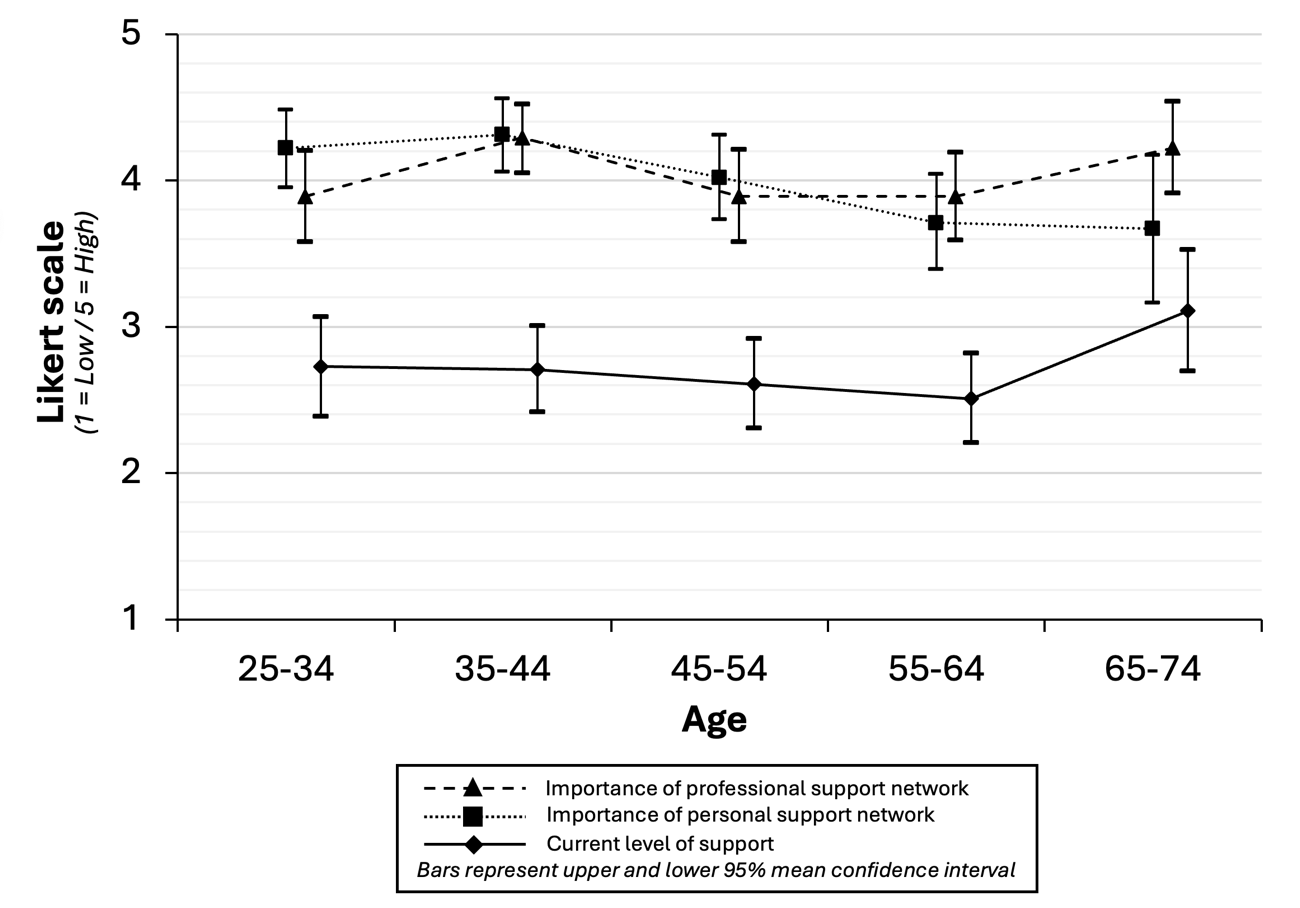
Figure 3. Importance of professional and personal support networks and perceived current level of support cut against age
Note: Due to limited responses, the 75+ age bracket has been excluded.
The qualitative data under the codes “Relationships, community, and humanity” and “Associations, regulation, and unions” further nuanced insights into freelance translators’ sense of belonging. Many shared the view that membership of a professional association, for instance, was a way to signal their belonging to a community with shared and recognised expertise. In the words of one participant, this allows them “to show that you're a professional translator rather than somebody passing off machine translation as your work” (FG-1-01). This hints at the fact that belonging to a professional association may be a way for freelance translators to enjoy some much-needed professional recognition as the latter may not be as forthcoming beyond their own professional circles. Beyond this need for recognition, which we explore in more detail in Section 4.2, all focus groups mentioned how helpful and supportive the freelance translator community can be on social media (e.g. LinkedIn). However, some participants shared that engaging with this online community can be a double-edged sword. Indeed, “[i]t's great we all share advice with each other, but it doesn't help when you've got people […] who make you feel a bit small.” (FG-3-02). Furthermore, some translators mentioned that the source of their stress was not necessarily the industry itself (although it certainly contributed to it), but the online community of fellow translators who are seen as constantly self-promoting on social media (FG-2-05).
That notwithstanding, the community of fellow professional translators was mostly seen as a valuable source of professional support with freelance translators not seeing each other as competitors but as “trusted colleagues” (FG-2-05) who “help each other” (FG-1-01) and even “give [each other] work” (FG-2-08). In fact, participants also thought that belonging to a professional association could help newcomers enter the freelance translation market thanks to the mentoring and networking opportunities they offer. In a similar vein, professional association membership was also seen as a way to ward off isolation in this “somewhat solitary job” (FG-3-04). This is because they allow freelance translators to “get to know colleagues and how they're working, what difficulties they’re facing” (FG-1-03), and to share industry knowledge. Indeed, despite the fact that freelance translators are a very diverse community (Penet, 2025), most felt they had a lot in common:
I think the perception is that translators follow disparate paths and we're all terribly different because all of our specialisms, infinite combinations… Actually, we're all fighting the same battle here. You know, there are far more commonalities than there are differences. (FG-2-05)
This sense of shared battle may explain why several of the focus group respondents mentioned unionising as a way to collectively fight some of the market pressures they are facing. According to one of them, “the most obvious direct thing we can do is unionise. Beyond that, it's just market conditions and I'm not sure how much effect we have over those” (FG-3-10). Finally, despite the fact that some participants felt that belonging to a professional association led to greater “prestige”, which could then be used as a “marketing tool” (FG-2-07), most had more intrinsic motivations. To them, belonging to a community of fellow freelance translators gives them the respect and recognition they often feel they lack outside that community: “I feel like I draw my self-worth professionally from my colleagues because I know that I'm regarded among the translators I know” (FG-1-05), a comment that leads us neatly into the next section on esteem, status, and recognition.
4.2. (Self-)Esteem, status, and recognition
In line with commonly reported findings in other studies (Ruokonen and Mäkisalo, 2018), when we look at translators’ esteem needs, there is a clear disconnect between how important translators consider their profession to be and the extent to which translators believe that the general public consider translators to be important to society. As shown in Figure 4, perhaps unsurprisingly, 80% of our sample considered translators to play an important or very important role in society (x̄ = 4.09 [3.96, 4.22]). Conversely, 77% felt that the general public would view their work as either unimportant or only slightly important (x̄ = 1.88 [1.76, 2.00]). To be clear, members of the public were not surveyed for their opinion, but we maintain that perceptions among translators are critical to understanding the extent to which esteem needs are or are not met in terms of psychological wellbeing and self-image. Indeed, as Clough and Strycharczyk note (2012, p. 276), “the subjective viewpoint is important; after all, […] much of behaviour is driven by attributions. It’s not ‘what is’ but rather ‘what we think and feel is’ happening that truly drive behaviour”. In this vein, when asked how well-regarded they felt as a professional translator in society, reflecting more their ‘actual’ encounters through their work, the results were slightly – but not considerably – more measured. Out of 209 responses, the mean still congregated around the middle, “indifferent” response (x̄ = 2.98 [2.85, 3.11]).
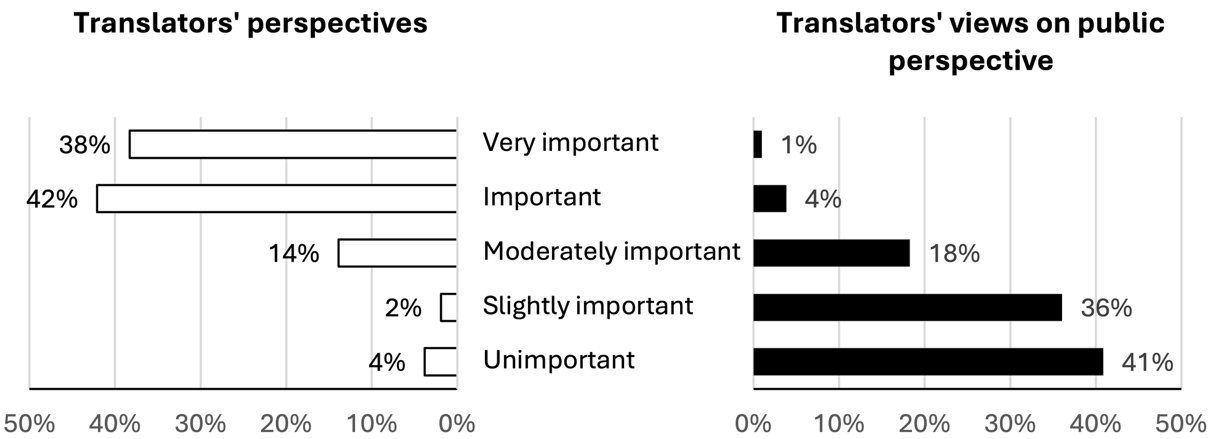
Figure 4. Translators' perceptions of their own importance (left, n = 209) vs their view on how the public perceives their importance (right, n = 208)
The qualitative responses of translators under the codes “Recognition and visibility”, “Power and agency”, “(Self-)worth”, and “Status and prestige” mirror the quantitative findings outlined above. Value, esteem, and visibility are seen as an important way to address wider issues with working conditions (thus concretising its importance in relation to the wellbeing and sustainability concerns at play here) and there is a universal agreement in the survey and focus group data that translation is valuable (“it’s important; it brings value. It’s a skill, you know” (FG-3-08)). This perception is a feeling that is often shared by “friends, colleagues, and generally by people I meet” (S-117343942) as one participant put it, echoing others’ views. But “[translators’] role is so poorly understood in society and essentially invisible” (S-117701876); “the difficulty is selling that importance to the buyer. And the buyers […] don’t understand” (FG-2-02). Indeed, while several participants compared their work to lawyers in terms of the professionalism and skill required, they simultaneously echoed the feeling that “the way we are perceived is, like, right at the bottom” (FG-2-04) among the general public.
As a result of this lack of regard outwardly, several translators mentioned that their sense of esteem comes from within the translation profession, e.g. being “regarded among the translators I know”, and within online networks such as on LinkedIn. Some said that they felt well regarded by direct clients, but not LSPs, which, one translator commented was “ironic” given that “agencies are in our industry, [and] therefore, should be understanding our value and our work” (FG-1-07, also echoed by S-117195359). The picture was not entirely negative however: others did refer to a warm relationship with clients, something they valued. Notably this sense of esteem is something that contributes to translators’ self-worth professionally.
However, there was also some frustration at the inward-looking nature of discussions of value – i.e. translators talking to each other about the value that they add – as several participants felt that instead of talking amongst ourselves, “the world has got to be educated about what we do” and “we need to get a lot better” at “shouting about everything we do and articulating it in a public forum” (FG-2-05). Several participants suggested that associations must do more on this front, while another commented that a minimum level of qualification could be used to distinguish translators (something that is not a requirement in the UK). Another translator also lamented the so-called navel-gazing associated with discussions of recognition and esteem:
So many translators are bumbling along really struggling this year, particularly, to even make enough money to live. So the fact that they might not be respected is the last thing on their minds. It's actually, we need to afford our monthly outgoings, we need to have some form of work-life balance, you know, so we don’t burn out. (FG-2-05)
4.3. Self-Actualisation, career progression, and fulfilment
While the general trend in attitudes on the importance of career progression may be predictable (46.3% of respondents rated career progression as important or very important; x̄ = 3.31 [3.14, 3.48]), the number of years’ experience had a clear moderating influence. Those with less than ten years’ experience rated the importance of career progression highest (x̄ = 3.67 [3.44, 3.90]), followed by those with between eleven and twenty years’ experience (x̄ = 3.02 [2.63, 3.42]), and then those with twenty-one or more years’ experience (x̄ = 3.01 [2.71, 3.22]). Expectedly, the inverse trend was seen for respondents’ satisfaction with their own career progression. Though the mean was similar (x̄ = 3.35 [3.20, 3.49]) to their rating of the importance of career progression, and again 49.8% of respondents reported being somewhat or very satisfied with their career progression, years’ experience had a predictable impact on the results. Those with less than ten years’ experience were less satisfied with their career progression (x̄ = 3.14 [2.91, 3.38]) than those with eleven to twenty years’ experience (x̄ = 3.40 [3.09, 3.72]) and, in turn, than those than twenty-one years’ experience or more (x̄ = 3.38 [3.38, 3.85]).
Within our qualitative data, using the codes “(Self-)worth”, “Creativity and craft”, Development, learning, training, and CPD”, “Knowledge, expertise, and skills (competence)”, and “Progression and growth”, there was a very strong sense among respondents and participants that traditional “opportunities for progression are limited” (FG-1-07, echoed across survey responses too), with this lack of potential being tied to the current industry context. As one participant bluntly put it, “I think we're aware that there's no progression” (FG-2-09), which sparked a short discussion about the nature of progression, culminating in the agreement that progression in freelance translation is more limited than, and very different to, typical corporate progression (FG-2-06 and FG-2-09). While some participants were happy to shun what they considered to be “pressure by society” to “always be progressing” (FG-1-03), this lack of career development tied into another participant’s overall sense of (dis)satisfaction in their career: “I need a little bit more stimulation. I need something to aim for, but the progression within my career path now, I just can't really see where that would lead to” (FG-1-07).
However, this lack of career progression on a general level was contrasted with abundant opportunities for “personal development”. This was seen as something that was necessary, something that is inherent to translation, and something that translators appreciated, though multiple participants noted that, despite the fact that “a lot of us do a lot of hours of CPD” (FG-3-04), the onus is on translators themselves to “find your own training” (FG-1-09, echoed by S-117180010), organise that in your own time, sacrifice pay to complete it, or pay for the training itself (S-117580485 and S-118259277).
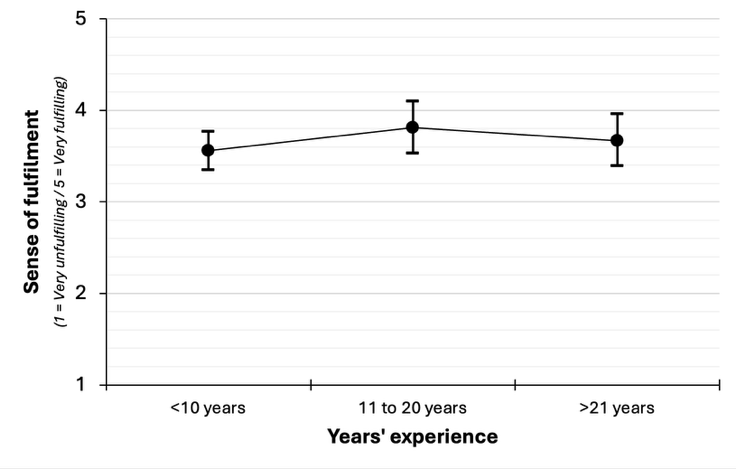
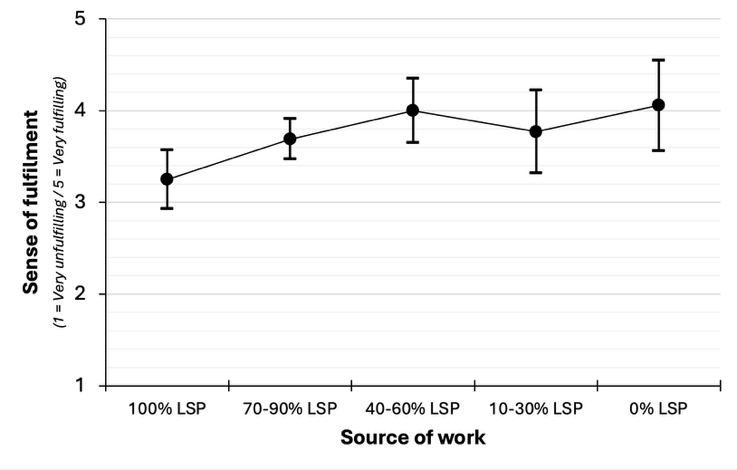
With regard to a generalised sense of fulfilment with their careers, overall, translators were somewhat or very fulfilled (69.8% of 208 respondents, x̄ = 3.64 [3.49, 3.79]). Despite this broadly rosy picture, roughly one fifth of respondents reported finding their career somewhat or very unfulfilling (20.7%), which remains a cause for concern, but might raise the question of whether similar statistics would in fact be found in all professions9. On closer examination, a number of factors appear to have a moderating influence on this statistic. For instance, when plotted against years of experience (see Figure 5), mean fulfilment is lowest for those with less than ten years’ experience (n = 91, x̄ = 3.56 [3.35, 3.77]), followed by those with over twenty-one years’ (n = 73, x̄ = 3.67 [3.39, 3.96]), and there is a notable ‘peak’ in fulfilment for those in the interim eleven-to-twenty-year period (n = 43, x̄ = 3.81 [3.53, 4.10]). Source of work also appears to have an impact on perceived fulfilment (see Figure 66), with those who work exclusively for LSPs the least fulfilled (n = 53, x̄ = 3.23 [2.91, 3.54]) and those who work exclusively for direct clients the most fulfilled (n = 18, x̄ = 4.06 [3.56, 4.55]). The data showed that men (n = 43, x̄ = 3.44 [3.09, 3.79]) also felt slightly less fulfilled in their work than women (n = 162, x̄ = 3.72 [3.55, 3.88]). While none of these averages suggests any widespread discontent among translators, and in fact imply that the sense of fulfilment among translators is actually quite high, the analysis of some of the factors that condition the averages reveal noteworthy trends about potential sources of discontent.
Returning to our qualitative data once again, we find that translation is seen as hugely fulfilling in terms of the core activity itself. Translation is described by multiple participants as an art rather than a science, the work is repeatedly described as enjoyable and intellectually stimulating, and this is something that is hugely important to translators in spite of other challenges. As two participants summarised:
I value the craftsmanship of it, that it's an art, that it's something that I can feel proud about doing on my own, using my knowledge and my expertise and creating something that requires a certain skill set, a certain dedication, a certain commitment to perfection. (FG-1-07)
Every day, you're trying to do something you actually enjoy as part of your professional setup. It feeds […] back into that idea of [being] in control: you have this choice, your life is not “oh I have to do my nine to five and then I have fun”. It's actually: I'm having an intellectually satisfying day, all day. Even though there are all these challenges to face as well. (FG-2-05)
Finally, one participant commented on the fact that their role as a translator is closely linked to their identity overall:
I’ve identified as a translator for such a long time […]. If I am not a translator, what am I and where am I going with this? And what am I going to do with the rest of my –… you know, I’ve got thirty more years of employment or something that I need… What am I going to do with my life? (FG-3-05)
These questions of meaningfulness (cf. Penet et al., in press), identity, and agency call to mind a range of interconnected research strands across TS (including sociological and economic perspectives and translator studies) and represent valuable channels to explore further. Below, we seek to draw out some key findings in relation to wellbeing and SD.
5. Affirmation of the motivation-satisfaction paradox
Reflecting on the analyses above, translators clearly have a fractured sense of belonging. While belonging to communities of practice and having support networks were deemed to be important, many felt that they were not part of these communities and, notably, did not feel well supported. Returning to Figure 2, this may reflect a gap in their social resources.
In terms of esteem, it was clear that within the community of translators and in relation to their self-perceptions, translators felt that their work has value, is important, and is appreciated. However, there is an almost inverse relationship between these internal perceptions and perceptions of external esteem beyond the immediate world of translation – among the general public, for instance. This echoes Ruokonen and Mäkisalo (2018, p.14), who observed “a conflict between translators’ own work being appreciated and the profession at large being undervalued” among Finnish translators. Translators agree that these external viewpoints are important in terms of professional visibility (and, consequently, helping to define working conditions, etc.) and passionate calls for greater understanding on a wider scale hint that this need for recognition has an impact, in spite of the more positive internal context. Again, this could have a negative impact upon both their social and psychological resources.
When it comes to self-actualisation, meanwhile, career progression was unsurprisingly deemed to be important, but the rather idiosyncratic nature of freelance work in general, and freelance translation work specifically, means that pathways to progression and forms this progression can take are often unclear, reflected in mixed levels of satisfaction with career progression overall. Our data also reflected abundant opportunities for personal development and the fact that this was regarded as something of value to translators professionally and personally. Finally, and positively, translators generally reported drawing significant fulfilment from their work, despite some concerning moderating factors – with men, less experienced translators, and those working exclusively with LSPs reporting less fulfilment. Despite some of the issues we have noted concerning belonging, esteem, and progression, which may lead to a deficit in (mostly social) resources for translator wellbeing, fulfilment could provide translators with the psychological resources they need to offset potential challenges and, in the process, maintain their wellbeing.
Overall, this paints a rather two-sided picture in relation to Maslow’s hierarchy and these empirical findings support the hypothesised motivation-satisfaction paradox, whereby translators achieve considerable self-actualisation despite deficits at lower levels. Indeed, there are gaps and issues throughout each level in the data analysed here, but translators are fairly fulfilled on the whole, and their work enables them to not only maintain an important degree of independence, but also to attend to higher order needs of self-actualisation, at least when it is intellectually-stimulating and affords opportunities for creativity and developing knowledge and expertise. As we previously argued, enjoyment of the work itself can be a “significant motivating factor for translators in spite of other shortcomings” (Lambert and Walker, 2024, p. 99). Such positive aspects seemingly enable significant trade-offs in lower-order needs, in some cases offsetting issues such as low pay, isolation, stress, and wider dissatisfaction. However, these positive pulls are clearly not always enough to offset other challenges, and the extent to which the fulfilling nature of the work itself has been challenged of late by the increase in post-editing commissions, for instance – with roles sometimes reduced to mere error verification (O’Brien and Conlan, 2018, p. 84) – is a key cause for concern in relation to their psychological resources. With industry observers simultaneously reporting that traditional “bread-and-butter translation work is diminishing” (Nimdzi, 2025, p. 10) and that a majority of LSPs plan on pushing MT-driven service offerings further in an effort to offset inflation and economic pressures (Nimdzi, 2025, p. 53), this is an area that should be monitored closely. Ultimately, if a major driver of satisfaction continues to be eroded in the coming years (though it must be said that not everyone views machine translation post-editing negatively), this risks exacerbating existing human capital retention challenges. All this seems to confirm Penet et al’s (in press) conclusion that, while it is positive to see that “most translators conside[r] their work fulfilling”, their more negative emotions also betray their perception that “the basis for meaningful work, i.e. underlying job quality, is being seriously eroded” and this, in turn, may impact on their sense of wellbeing.
6. Conclusion: Duty to (self-)care
Overall, what emerges from our research is that translator wellbeing as conceptualised in Figure 2 may well be at tipping point in the UK. Indeed, our findings identify notable gaps in some of the social and psychological resources UK freelance translators may need to maintain their wellbeing in the face of current industry challenges. For instance, our study, which provides convincing empirical evidence to support the motivation-satisfaction paradox we had hypothesised, shows that some UK freelance translators feel that the new, increasingly automated translation models are ‘grinding them down’. Combined with their perception that career progression for freelance translators remains limited, this could lead to a depletion of their psychological resources and, therefore, the belief they can self-actualise in their work. Similarly, the fractured sense of belonging we have identified, as well as perceived low status, could lead to a depletion of freelance translators’ perceived social and psychological resources which, again, may jeopardise their ability to maintain workplace wellbeing.
Viewing translator wellbeing as the foundation for the industry’s sustainability, all key stakeholders in the translation industry have not only a duty to care, but a duty of care, as failing to do so could have serious implications for the sustainability of the entire industry as a whole (see Figure 1). Indeed, if UK freelance translators struggle to access sufficient resources to maintain their workplace wellbeing, they will not feel in a position to help address the industry’s SD concerns ethically. Furthermore, even if they enjoy their work, if UK freelance translators feel that they cannot suitably develop in their careers, that the support they enjoy is fractured, and that they lack recognition as a professional community – with these concerns often exacerbated among younger professionals – this will likely have serious implications for human capital retention. For translator wellbeing to be truly sustainable, there is therefore an urgent need for a collective approach that recognises that “well-being is a complex issue, determined not only by the resources that individuals have at their disposal, but by the living conditions and societal forces that they are exposed to” (Searle, 2008, p. 30) and takes social context into consideration.
However, translator wellbeing is also a matter for individuals. This is why, beyond this collective duty to care, freelance translators (and researchers) also have the duty to self-care so they can actively maintain their wellbeing. As Bosseaux puts it, “we must cultivate space to care for ourselves and the communities we engage with” (2025, p. 137). Inspired by positive psychology, self-care here is understood as “the deliberate practice of activities that keep a person healthy, engaged, and well-functioning" (Costa et al., 2020, p. 36). Interestingly, though Hubscher-Davidson’s (2018) research has established a clear correlation between the way individual translators perceive, regulate, and express their emotions and their ability to thrive in the profession, self-care for professional translators still remains woefully under-researched despite some notable exceptions (Penet, 2024a; Hubscher-Davidson, 2024). Future research could therefore draw on what has been done for interpreting (e.g. Costa et al., 2020; Yan and Jia, 2025) to empirically explore the role and effectiveness of self-care for translator wellbeing and human capital sustainability.
Acknowledgements
The “Chasing Status: The Sustainability of the Freelance Translation Profession in the United Kingdom” project was funded by the British Academy/Leverhulme Trust, grant SRG2223\230565.
References
Bednárová-Gibová, K. & Majherová, M. (2021). A comparative study of professional well-being in agency and freelance translators. Cadernos de Traduçao, 41(2), 109–136. https://doi.org/10.5007/2175-7968.2021.e76280
Bosseaux, C. (2025). A voice of their own: encouraging caring and ethical practices in trauma screen translation. Palgrave.
Chen, T. (2023). The interplay between psychological well-being, stress, and burnout: implications for translators and interpreters. Heliyon, 9(8), e18589. https://doi.org/10.1016/j.heliyon.2023.e18589
Chiesa, R., Fazil, L., Guglielmi, D., & Mariani, M. G. (2018). Enhancing substainability: psychological capital, perceived employability, and job insecurity in different work contract conditions. Sustainability, 10(7), 2475. https://doi.org/10.3390/su10072475
Clough, P. & Strycharczyk, D. (2012). Developing mental toughness. Improving performance, wellbeing and positive behaviour in others. Kogan Page.
Costa, B., Lázaro Gutiérrez, R., & Rausch, T. (2020). Self-care as an ethical responsibility: A pilot study on support provision for interpreters in human crises. Translation and Interpreting Studies, 15(1), 36–56. https://doi.org/10.1075/tis.20004.cos
Dam, H. V. & Zethsen, K. K. (2016). “I think it is a wonderful job”: On the solidarity of the translation profession. The Journal of Specialised Translation, 25, 174–187. https://doi.org/10.26034/cm.jostrans.2016.305
Dodge, R., Daly, A. P., Huyton, J., & Sanders, L. D. (2012). The challenge of defining wellbeing. International Journal of Wellbeing, 2(3), 222–235.
Ehrensberger-Dow, M. (2020). Translation, ergonomics and cognition. In F. Alves & A. L. Jakobsen (Eds.), The Routledge Handbook of Translation and Cognition (pp. 147–160). Routledge.
ELIS. (2025). European Language Industry Survey 2025: Trends, expectations and concerns of the European language industry. https://elis-survey.org/wp-content/uploads/2025/03/ELIS-2025_Report.pdf
Elkington, J. (1997). Cannibals with forks: the triple bottom line of 21st century business. Capstone.
Fırat, G. (2021). Uberization of translation: impacts on working conditions. The Journal of Internationalization and Localization, 8(1), 48–75. https://doi.org/10.1075/jial.20006.fir
Fırat, G., Gough, J., & Moorkens, J. (2024). Translators in the platform economy: a decent work perspective. Perspectives: Studies in Translation Theory and Practice, 32(3), 422–440. https://doi.org/10.1080/0907676X.2024.2323213
Giustini, D. (2024). ‘You can book an interpreter the same way you order your uber’: (re)interpreting work and digital labour platforms. Perspectives: Studies in Translation Theory and Practice, 32(3), 441–459. https://doi.org/10.1080/0907676X.2023.2298910
Hanson, T. A., Mellinger, C. D., & Walker, C. (2025). Economic perspectives on the translation industry. In C. Walker & J. Lambert (Eds.), The Routledge Handbook of the Translation Industry (pp. 267–289). Routledge.
Hubscher-Davidson, S. (2018). Translation and emotion: a psychological perspective. Routledge.
Hubscher-Davidson, S. & Lehr, C. (2022). The psychology of translation: an interdisciplinary approach. Routledge.
Hubscher-Davidson, S. (2024). Psychological sustainability in the translation professions. Mikael, 17(1), 3–25. https://doi.org/10.61200/mikael.135918
Hubscher-Davidson, S. & Panichelli-Batalla, S. (2025). Global sustainable development and wellbeing. In C. Walker & J. Lambert (Eds.), The Routledge Handbook of the Translation Industry (pp. 444–459). Routledge.
Lambert, J. & Walker, C. (2022). Because we’re worth it: disentangling freelance translation, status, and rate-setting in the United Kingdom. Translation Spaces, 11(2), 277–302. https://doi.org/10.1075/ts.21030.lam
Lambert, J. & Walker, C. (2024). Thriving or surviving: motivation, satisfaction, and existential sustainability in the translation profession. Mikael, 17(1), 89–104. https://doi.org/10.61200/mikael.136209
Mahadin, D. & Naser Olimat, S. (2022). In their own words: how has Covid-19 affected Jordanian translators’ wellbeing? The Translator, 28(4), 489–505. https://doi.org/10.1080/13556509.2022.2159284
Monzó-Nebot, E. & Tasa-Fuster, V. (2024). Interconnected, dependent, and dependable translation automation. In E. Monzó-Nebot & V. Tasa-Fuster (Eds.), The social impact of automating translation: an ethics of care perspective on machine translation (pp. 1–11). Routledge.
Moorkens, J. (2020). Translation in the neoliberal Era. In E. Bielsa & D. Kapsaskis (Eds.), The Routledge Handbook of Translation and Globalization (pp. 323–336). Routledge.
Moorkens, J., Castilho, S., Gaspari, F., Toral, A., & Popović, M. (2024). Proposal for a triple bottom line for translation automation and sustainability: an editorial position paper. The Journal of Specialised Translation, 41, 2–25. https://doi.org/10.26034/cm.jostrans.2024.4706
Nimdzi. 2025. The 2025 Nimdzi 100. https://www.nimdzi.com/nimdzi-100-2025/
O'Brien, S. & Conlan, O. (2018). Moving towards personalising translation technology. In H. Dam, M. Brøgger, & K. K. Zethsen (Eds.), Moving boundaries in translation studies (pp. 81–97). Routledge.
Penet, JC. (2024a). Working as a professional translator. Routledge.
Penet, JC. (2024b). Coaching in translator education: exploring the potential benefits of group coaching in simulated translation bureaus and beyond. In M. Ward, C, Eugeni, & C. Walker, C. (Eds.), Teaching translation: contexts, modes and technologies (pp.145–165). Routledge.
Penet, JC. (2025). Freelance translation. In C. Walker & J. Lambert (Eds.), The Routledge Handbook of the Translation Industry (pp. 43–58). Routledge.
Penet, JC., Walker, C., & Lambert, J. (in press). Love’s labour’s found? A data-driven exploration of job quality among UK-based freelance translators. Target.
Pollard, E. & Lee, P. (2003). Child well-being: a systematic review of the literature. Social Indicators Research, 61(1), 59–78. https://doi.org/10.1023/A:1021284215801
Riemland, M. (2023). Theorizing sustainable, low-resource MT in development settings: pivot-based MT between Guatemala’s indigenous Mayan languages. Translation Spaces, 12(2), 231–254. https://doi.org/10.1075/ts.22018.rie
Rodríguez-Castro, M. (2015). Conceptual construct and empirical validation of a multifaceted instrument for translator satisfaction. Translation and Interpreting: The International Journal of Translation and Interpreting Research, 7(2), 30–50. https://doi.org/10.12807/ti.107202.2015.a03
Rogers, C. (1967). On becoming a person: a therapist’s view of psychotherapy. Constable & Robinson.
Ruokonen, M. & Mäkisalo, J. (2018). Middling-status profession, high-status work: Finnish translators' status perceptions in the light of their backgrounds, working conditions and job satisfaction. Translation & Interpreting, 10(1), 1–17. https://doi.org/10.12807/ti.110201.2018.a01
Ruokonen, M. & Svahn, E. (2024). What do we know about translators’ job satisfaction? An exploratory overview of research results. Translation Spaces, 13(1), 7–13. https://doi.org/10.1075/ts.23019.ruo
Savill-Smith, C. & Scanlan, D. (2022). Education support: teacher wellbeing index 2022. https://www.educationsupport.org.uk/media/zoga2r13/teacher-wellbeing-index-2022.pdf
Scaria, D., Brandt, M.L., Kim, E. & Lindeman, B. (2020). What is wellbeing? In E. Kim, & B. Lindeman (Eds.), Wellbeing (pp. 3–10). Springer.
Searle, B. A. (2008). Well-being: in search of a good life? Bristol University Press.
UNWCED (United Nations World Commission on Environment and Development). (1987). Report of the World Commission on Environment and Development: Our Common Future. http://www.un-documents.net/ our-common-future.pdf
Walker, C. & Lambert, J. (2024). Show me the money: bringing pay, rate-setting, and financial sustainability into the translation classroom. In M. Ward, C. Eugeni, & C. Walker (Eds.), Teaching Translation: Contexts, Modes and Technologies (pp. 27–52). Routledge.
Yan, D. & Jia, C. (2025). Occupational stress and turnover intentions among simultaneous interpreters: the mediating role of burnout and the moderating role of grit. Perspectives: Studies in Translation Theory and Practice. https://doi.org/10.1080/0907676X.2025.2478403
Notes
1 This seems particularly true for translation; ELIS simultaneously report that “voice related services (interpreting, audiovisual) […] are reported to even be thriving” (ELIS 2025, p. 5).
3 While the ‘Planet’ pillar is, ultimately, the basis for all development, this area sits beyond the scope of this article in light of our focus on human capital issues (the rationale for which is addressed in Lambert and Walker 2024, p. 90).
4 See https://www.iti.org.uk/resource/position-statement-on-translators-mental-health-and-wellbeing.html
5 See https://www.ciol.org.uk/health-and-wellbeing-0
6 It is worth noting, however, that in the context of translation, Lambert and Walker (2024) suggest that translators will attend to higher-level categories despite unfulfilled lower-level needs.
7 The full list of questions in the questionnaire and focus group discussion prompts can be consulted at: https://ahc.leeds.ac.uk/download/downloads/id/1006/questionnaire-and-focus-group-prompts.pdf. The study was reviewed and given a favourable opinion by the Faculty of Arts, Humanities, and Cultures Research Ethics Committee of the University of Leeds (the lead institution) on 28 June 2023, reference LTSLCS-163.
8 See https://lumivero.com/products/nvivo/
9 In the UK, for instance, the 2022 Teacher Wellbeing Index survey (3,082 education professionals) showed that 59% of schoolteachers considered leaving the sector. The most common reason behind this was heavy workloads (66%). However, we should note that another commonly-given reason was “not feeling valued” (60%) (Savill-Smith and Scanlan, 2022, p. 37).